
Resistance Training Guidelines for Beginners: A Simple Home Workout Plan for 2026
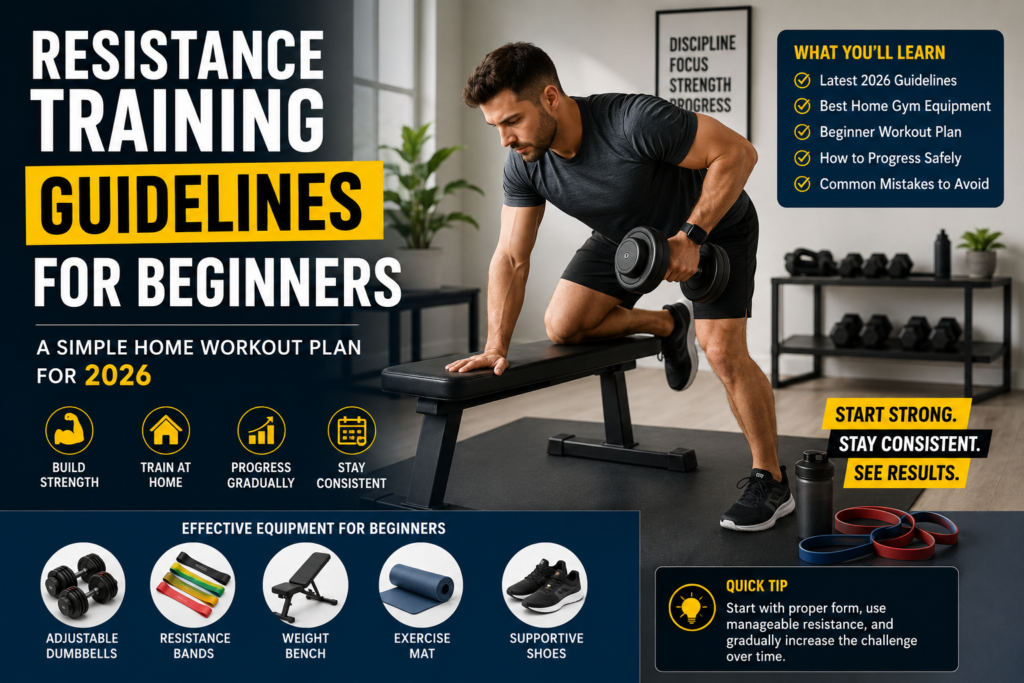
Starting strength training can feel confusing.
Table of Contents
ToggleOne fitness creator says you need heavy barbells. Another says you need expensive gym machines. Someone else tells you to train until complete muscle failure every day.
The truth is much simpler.
You do not need a commercial gym, advanced equipment, or a complicated workout plan to get stronger. With the right exercises, gradual progression, and a routine you can repeat consistently, you can build strength at home using bodyweight movements, resistance bands, adjustable dumbbells, or a compact home gym setup.
This beginner-friendly guide explains the latest resistance training principles, what equipment you actually need, and how to create a realistic home workout routine that fits your schedule.
Quick answer: For most beginners, two full-body strength sessions per week are an effective starting point. Focus on simple movements such as squats, presses, rows, hinges, carries, and core exercises. Start with manageable resistance, use good form, and gradually make the workout more challenging over time.
What Is Resistance Training?
Resistance training is any exercise where your muscles work against resistance.
That resistance can come from:
- Your own bodyweight
- Resistance bands
- Dumbbells
- Kettlebells
- Barbells
- Cable machines
- Weight machines
- Suspension trainers
- Everyday objects such as a loaded backpack
The purpose is not simply to lift heavier weights. The goal is to challenge your muscles in a controlled way so they adapt over time.
Regular resistance training can support strength, muscle development, physical confidence, mobility, posture, and daily movement. It can also make common activities easier, including carrying groceries, climbing stairs, lifting children, and moving furniture.
For beginners, the best training plan is not the hardest workout. It is the one you can perform safely and consistently.
The Biggest Resistance Training Takeaways for Beginners
Modern strength training guidance is moving away from overly complicated programs.
You do not need to follow a perfect bodybuilding split, buy a machine for every body part, or spend hours in the gym to make progress.
Here are the principles that matter most.
1. Consistency Matters More Than Complexity
A simple routine completed every week is far more valuable than a complicated plan you quit after ten days.
Start with two strength sessions per week. Once this feels normal, you can consider increasing your training frequency based on your goals, recovery, and available time.
2. You Can Build Strength at Home
Home workouts can be effective when they include enough resistance and gradually become more challenging.
Bodyweight exercises, resistance bands, adjustable dumbbells, and a sturdy workout bench can create a highly effective beginner home gym setup.
You do not need a large garage gym to train your full body.
3. Train the Major Movement Patterns
Instead of choosing random exercises, build your workouts around key movement patterns.
A balanced beginner routine should include:
- Squat: bodyweight squat, goblet squat, chair squat
- Hinge: Romanian deadlift, hip hinge, glute bridge
- Push: push-up, dumbbell chest press, shoulder press
- Pull: dumbbell row, resistance-band row, lat pulldown
- Single-leg movement: split squat, reverse lunge, step-up
- Core stability: plank, dead bug, side plank, farmer carry
These movements help you train the major muscle groups without needing dozens of separate exercises.
4. You Do Not Need to Train Until Failure
Muscle failure means reaching the point where you cannot complete another repetition with good form.
Training close to failure can be useful for experienced lifters, but it is not necessary for beginners.
For your first few months, focus on controlled repetitions and leave a little energy in reserve. Stop the set when your form starts breaking down.
This makes training safer, easier to recover from, and more sustainable.
5. Progress Gradually
Strength training works when your body receives a reason to adapt.
You can make an exercise more challenging by:
- Adding a few repetitions
- Increasing the resistance
- Adding one more set
- Using a slower lowering phase
- Improving your range of motion
- Choosing a more difficult exercise variation
- Reducing excessive rest time
You do not need to increase the weight every session. Small improvements over several weeks create meaningful progress.
How Often Should Beginners Do Resistance Training?
For most beginners, two full-body sessions per week are a practical place to start.
For example:
- Monday: Full-body strength workout
- Tuesday: Light walking, stretching, or rest
- Wednesday: Rest or gentle cardio
- Thursday: Full-body strength workout
- Friday: Walking, mobility, or rest
- Weekend: Optional cardio, outdoor activity, or recovery
This schedule gives your muscles time to recover while helping you build a regular training habit.
As you gain experience, you may choose to train three or four days per week. However, more training is not automatically better. The best schedule is one you can maintain without constant fatigue, pain, or burnout.
The Best Home Gym Equipment for Beginners
You can start with very little equipment. Avoid buying a full collection of machines before you know what type of training you enjoy.
Here are three practical beginner setups.
Option 1: No-Equipment Beginner Setup
This is ideal for people who want to begin immediately.
You only need:
- A clear floor space
- Supportive shoes
- A yoga or exercise mat
- A stable chair or bench
- A backpack that can be loaded with books or bottles
Useful exercises include squats, incline push-ups, glute bridges, reverse lunges, planks, and backpack rows.
Option 2: Budget Strength Training Setup
This setup offers more exercise variety without taking much space.
Recommended equipment:
- Resistance bands
- Adjustable dumbbells
- Exercise mat
- Door anchor for bands
- Foam roller for recovery
Adjustable dumbbells are one of the most versatile investments for a small home gym because they can be used for squats, presses, rows, lunges, deadlifts, curls, carries, and many other exercises.
Internal link opportunity: Link the phrase “best adjustable dumbbells for home workouts” to your existing Best Adjustable Dumbbells Under $300 in 2026 article.
Option 3: Complete Small-Space Home Gym Setup
For people who want to train more seriously at home, consider adding:
- Adjustable dumbbells
- Adjustable weight bench
- Resistance band set
- Compact cardio equipment
- Foldable treadmill or walking pad
- Pull-up bar or suspension trainer
A compact bench can expand your workout options significantly by allowing you to perform dumbbell presses, supported rows, split squats, hip thrusts, and seated shoulder presses.
Internal link opportunity: Link the phrase “compact weight bench for a small home gym” to your existing Best Compact Weight Bench for Small Spaces article.
Beginner Resistance Training Workout Plan at Home
This simple two-day plan is designed for beginners with bodyweight, resistance bands, or dumbbells.
Start with one or two sets of each exercise. Choose a resistance level that feels challenging near the final repetitions while still allowing good form.
Rest for around 60 to 90 seconds between sets.
Workout A: Full-Body Strength Foundation
| Exercise | Sets | Repetitions |
|---|---|---|
| Bodyweight Squat or Goblet Squat | 2–3 | 8–12 |
| Incline Push-Up or Dumbbell Chest Press | 2–3 | 8–12 |
| Dumbbell Row or Resistance Band Row | 2–3 | 8–12 each side |
| Glute Bridge or Dumbbell Romanian Deadlift | 2–3 | 10–12 |
| Plank | 2–3 | 20–40 seconds |
| Farmer Carry with Dumbbells | 2–3 | 20–40 seconds |
Workout B: Strength, Balance and Stability
| Exercise | Sets | Repetitions |
| Reverse Lunge or Split Squat | 2–3 | 8–10 each side |
| Dumbbell Shoulder Press or Band Press | 2–3 | 8–12 |
| Resistance Band Pulldown or Row | 2–3 | 10–15 |
| Hip Hinge or Romanian Deadlift | 2–3 | 8–12 |
| Side Plank | 2–3 | 15–30 seconds each side |
| Dead Bug | 2–3 | 8–12 each side |
Do not rush through the workout. Use slow, controlled repetitions and focus on learning the movement.
Good technique is more important than lifting a heavier weight too early.
How to Progress Your Home Strength Training Plan
Progress does not need to be dramatic.
Use this simple four-week approach.
Week 1: Learn the Exercises
Use light resistance and focus on posture, balance, range of motion, and control.
Your goal is to complete every exercise with confidence.
Week 2: Add a Few Repetitions
Try adding one or two repetitions to each set while keeping your form strong.
For example, move from eight repetitions to ten repetitions.
Week 3: Add a Set or Slightly Increase Resistance
Add one extra set to one or two key exercises, or move to a slightly heavier dumbbell or stronger resistance band.
Week 4: Review and Repeat
Look at your progress.
Ask yourself:
- Are the exercises feeling easier?
- Can you use better form?
- Can you add a little more resistance?
- Is your workout becoming more consistent?
- Do you need more recovery between sessions?
Then repeat the cycle with slightly more challenge.
Do You Need a Treadmill or Cardio Machine?
A treadmill, walking pad, exercise bike, or rowing machine can be useful, but it is not required for strength training.
Cardio and resistance training work well together because they support different areas of fitness.
A simple weekly routine could include:
- Two full-body strength sessions
- Several walking sessions
- One longer cardio session you enjoy
- Mobility or stretching on rest days
For people who work from home or live in apartments, a compact walking pad can make it easier to move more during the day without needing a dedicated workout room.
Internal link opportunity: Link “best under-desk treadmill for apartment living” to your existing under-desk treadmill guide.
Common Beginner Resistance Training Mistakes
Buying Too Much Equipment Too Soon
You do not need a commercial gym setup to get results.
Start with versatile tools such as dumbbells, resistance bands, and a workout bench. Upgrade only after you develop a regular training habit.
Internal link opportunity: Link “building a budget home gym” to your existing 10 Mistakes When Building a Budget Gym article.
Changing Your Workout Every Week
Your body needs time to practice and improve.
Keep the same core exercises for at least four to six weeks before making major changes.
Ignoring Form
Bad form can make an exercise less effective and increase injury risk.
Use lighter resistance until you can perform every repetition with control.
Training Too Hard at the Beginning
Feeling sore for days after every workout is not a sign of a perfect program.
Start conservatively. Leave room for recovery and gradual progress.
Forgetting About Daily Movement
Strength workouts are important, but daily activity matters too.
Walking, standing more often, taking movement breaks, and choosing stairs can all support an active lifestyle.
Frequently Asked Questions
Can beginners build muscle with home workouts?
Yes. Beginners can build strength and muscle at home with bodyweight exercises, resistance bands, dumbbells, or compact home gym equipment. The key is using enough challenge, practicing consistently, and progressing gradually.
Are resistance bands effective for strength training?
Resistance bands can be highly effective for beginner strength training. They are portable, affordable, easy to store, and useful for rows, presses, squats, glute exercises, arm exercises, and mobility work.
How many days per week should I lift weights as a beginner?
Two full-body strength workouts per week are a strong starting point for most beginners. As your fitness improves, you can add another session if recovery, schedule, and motivation allow.
Do I need heavy dumbbells to get stronger?
Not at the beginning. Lighter dumbbells, bands, and bodyweight movements can be effective when the final repetitions feel challenging and you gradually increase the difficulty over time.
What is the best equipment for a small home gym?
For most people, adjustable dumbbells, resistance bands, a workout mat, and a compact bench provide the best combination of versatility, value, and space efficiency.
Is resistance training better than cardio?
Neither is “better” for everyone. Resistance training helps build strength and muscle, while cardio supports endurance and heart health. A balanced routine usually includes both.
Final Thoughts
The best resistance training plan is not the most complicated one.
It is the plan you can repeat consistently, progress gradually, and enjoy enough to maintain long term.
You can start today with bodyweight exercises in a small room. You can build a practical home gym with adjustable dumbbells and resistance bands. You can add a compact bench, walking pad, or other equipment later as your goals become clearer.
Focus on the basics:
- Train your full body
- Use controlled form
- Start with two sessions per week
- Make small improvements over time
- Choose equipment that fits your space and goals
- Stay consistent
Strength is built one workout at a time.
Important note: This article is for educational purposes only. Speak with a qualified healthcare professional before starting a new exercise program, especially if you have an injury, chronic condition, recent surgery, or concerns about exercise safety.